

























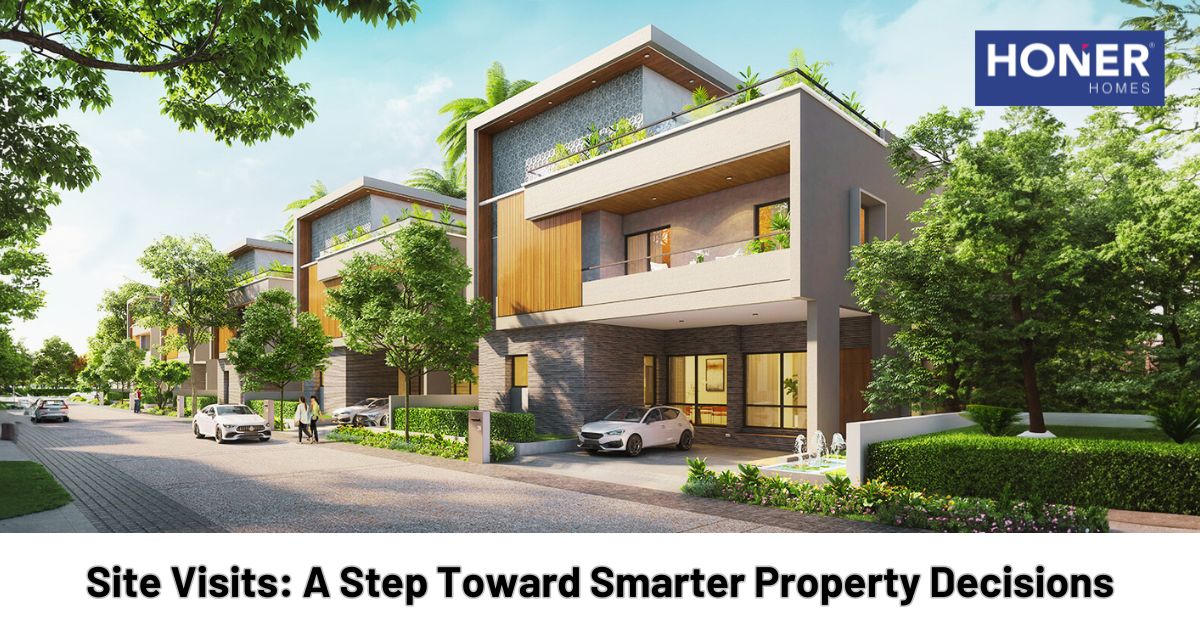
In the real estate journey, purchasing a property is often one of the most significant financial commitments a person makes. Amid the convenience of digital walkthroughs and online brochures, visiting the property site remains an irreplaceable step in making an informed decision. A site visit allows you to go beyond glossy images and sales pitches, offering an authentic experience that can shape your choice effectively.
For homebuyers in Hyderabad, where projects span micro-markets from Kukatpally to Gopanpally and Gachibowli, a site visit is often the step that separates a confident purchase from a regretted one.
Key Takeaways
- A site visit reveals what brochures cannot: actual room dimensions, construction stage, natural light quality, and finish standards.
- In Hyderabad, verify ORR connectivity during peak hours and visit the area after monsoon rain to assess drainage conditions firsthand.
- Ask for the material specification sheet and RERA documents on-site. Transparent developers provide both without hesitation.
- Visit at two different times: morning for natural light and ventilation, evening for neighbourhood safety and atmosphere.
- Walk through multiple projects in the same corridor before committing. It gives you a real-world basis for comparing value and asking prices.
- Every other step in home-buying can be done online. A site visit cannot.
Assessing the Reality Against Expectations
A site visit lets you verify whether a property actually matches its marketing. From room dimensions and construction stage to finish quality and natural light, physical inspection reveals details that no brochure or virtual tour can fully capture. For buyers evaluating under-construction projects, a site visit is how you track real progress against the promised timeline.
Glossy brochures and polished videos can spark interest. But you can only determine the true progress of a residential project when you see it in person. Floor plan dimensions on paper often feel different at scale. Ceiling heights, natural light ingress, and unit orientation are things you experience, not read.
“Ceiling heights, natural light ingress, and unit orientation are things you experience, not read.”
Evaluating the Location and Neighbourhood
Location is more than a pin on a map. A site visit lets you assess traffic patterns at different times of day, proximity to schools, hospitals, and retail, and the actual neighbourhood ambience. No online listing captures these accurately. For buyers in Hyderabad’s growth corridors, this step often determines whether a location works for daily life, not just investment logic.
During a site visit, you gain real-time insights into neighbourhood connectivity and accessibility to essential services. It also allows you to evaluate traffic conditions, public transport options, and noise levels. If you have been shortlisting gated communities based on location, a site visit is what converts that research into a confident decision.
For projects like Honer Richmont, visiting the site offers a chance to experience the neighbourhood’s exclusivity and ambiance firsthand, helping you determine if it fits your lifestyle.
When evaluating location in Hyderabad, pay specific attention to ORR access points, metro connectivity, and proximity to IT employment hubs like HITEC City, Financial District, and Wipro Junction. These factors directly influence daily commute quality and long-term demand for properties in these corridors.
One check many buyers overlook: visit the area during or just after a heavy rain shower. Hyderabad’s monsoon season runs from June to September, and water stagnation is a documented issue in several low-lying and rapidly expanding peripheral zones. Western corridor projects on elevated terrain are generally lower risk, but the only reliable way to confirm drainage conditions for a specific plot is to see it firsthand after rainfall.
Gauging Construction Quality
Construction quality cannot be assessed from brochures alone. A site visit lets you examine what is visible and accessible: finish quality in the model flat, common area standards, and surface-level indicators like flooring levelness, ventilation, and moisture marks. These observations, combined with the developer’s material specification document, give you a reliable picture without needing technical expertise.
The quality of construction significantly impacts the longevity and upkeep costs of a property. When visiting a site, pay attention to the following:
- Model flat finish quality: Check tile alignment and levelness, door and window frame execution, and paint finish consistency. Uneven flooring, visible tile gaps, and misaligned frames are reliable indicators of workmanship standards across the project.
- Ventilation and light in the unit: Walk through during the visit and note whether rooms feel naturally lit and ventilated. Hyderabad’s summer heat makes cross-ventilation a functional necessity. A unit that feels stuffy in a model flat will feel worse furnished and occupied.
- Visible surface defects in common areas: Look for moisture stains on walls or ceilings in lobbies, staircases, or lift areas. Visible cracks or seepage marks in accessible areas indicate either early maintenance issues or workmanship gaps worth investigating.
- Material specification sheet: Ask the sales team for the project’s specification document. Reputed developers provide this. It lists exact brands and grades for tiles, sanitary fittings, and electrical fixtures, letting you compare across projects on facts rather than impressions.
“A team that deflects or discourages specific queries about finish standards is itself a data point.”
Visualizing the Space and Layout
Blueprints and virtual renderings rarely convey the true sense of space. Walking through a unit shows you how natural light moves through rooms, how ventilation flows, and whether the layout works for the way your family lives, not just how it looks in a render.
A site visit enables you to walk through the property and visualise how your furniture will fit and how the space will function. It also offers an opportunity to assess natural lighting, ventilation, and overall spatial flow. Understanding the actual amenities on offer when buying an apartment becomes far easier when you experience them physically rather than through a brochure.
Honer Homes’ Experience Centre at IDL Access Road, Kukatpally, includes model apartments of Honer Signatis, allowing buyers to walk through actual unit layouts, assess spatial proportions, and evaluate finish quality before making a decision.
Validating Legal and Developmental Aspects
A property’s legal compliance and approval status cannot be fully verified online. During a site visit, you can request key documents, verify project approvals, and ask specific questions about possession timelines, steps that protect you from delays and legal complications after booking.
When visiting a project site, ask to see or confirm the following:
- RERA registration: Every project in Telangana must be registered with TSRERA. Verify the RERA number and check the project’s quarterly update history on the TSRERA portal. Stalled filings or outdated progress reports are a red flag.
- Commencement Certificate (CC): Confirms that construction has been legally approved to begin. Absence of a CC means construction may technically be unauthorised.
- Occupancy Certificate (OC): Relevant for ready-to-move properties. An OC confirms the building has been assessed and cleared for habitation by the relevant authority. Buying without OC can create complications at the registration stage.
- Building plan approval: Verify whether the sanctioned plan matches what is being constructed. Layout deviations from the approved plan can lead to legal complications down the line.
- Land title: Ask the developer for a title search report confirming the land has a clear, encumbrance-free title.
Developers who are transparent about approvals will make these documents readily available during a site visit.
Engaging with the Sales Team
A site visit gives you direct access to the project’s sales team, giving you an opportunity to clarify doubts, understand payment structures, and assess how responsive and transparent the developer is. The quality of that interaction often reflects how the developer approaches after-sales service.
Direct interaction with the sales team is valuable beyond just answering brochure-level questions. A team that addresses specific construction or legal queries, rather than deflecting to marketing material, is a positive indicator of developer credibility.
Come prepared with questions about: the current construction stage versus the RERA-committed schedule, OC and CC status, maintenance charges post-possession, and the process for snagging and defect resolution within the warranty period.
A site visit is also where you ground-truth value. Walking through multiple projects in the same corridor before committing gives you a real-world basis for comparing asking prices against what you are actually getting. What reads as premium in a brochure can feel ordinary in person, and vice versa. Use the visit to ask directly about payment plan structures, construction-linked versus time-linked schedules, and any bank tie-ups available on-site. These are conversations best had in person, where answers are harder to deflect.
“What reads as premium in a brochure can feel ordinary in person, and vice versa.”
Observing Surrounding Developments
The infrastructure around a project often matters as much as the project itself. During a site visit, observe what is coming up nearby: metro extensions, road widening projects, retail development, and IT expansion. In Hyderabad’s growth corridors, proximity to announced but not-yet-complete infrastructure can significantly influence long-term demand.
Beyond the property itself, site visits give you a sense of ongoing and upcoming developments in the area. In Hyderabad’s western and north-western corridors, specific signals to look for include:
- ORR access: Properties near ORR access points tend to attract stronger buyer demand due to multi-directional connectivity. Check actual road conditions and travel time to the nearest ORR junction during peak hours, not on a Sunday morning.
- Metro Phase 2 alignment: Hyderabad Metro’s Phase 2 expansion has proposed corridors through several under-served areas. Proximity to announced metro stations can affect future rental yields and resale value.
- HMDA development zones: Check whether the surrounding area falls within HMDA’s sanctioned master plan zones. Land zoned for commercial or institutional use nearby often leads to better long-term liveability and demand.
- Retail and social infrastructure: The presence of operational schools, hospitals, and daily convenience retail within 2-3 km matters more to end-users than investors. If these are still under development, factor in the realistic timeline.
Getting the Most from Your Site Visit
Most buyers visit once, on a weekday morning, and leave within an hour. A well-used site visit is more deliberate than that. Visiting at different times, speaking to existing residents, and testing the actual commute during peak hours are three habits that separate an informed decision from a box-ticking exercise.
Visit at different times. A morning visit checks natural light and ventilation. An evening visit reveals the neighbourhood’s actual atmosphere: street lighting, activity levels, and safety after sundown. If a locality feels noticeably different at 7 PM than it did at 11 AM, that difference is worth factoring in.
Talk to residents if the project is partially occupied. Existing residents give you feedback that no sales team will: water supply reliability, power backup quality, maintenance response times, and any recurring issues. A five-minute conversation near the parking area or lift lobby is worth more than an hour with the brochure.
“A five-minute conversation near the parking area or lift lobby is worth more than an hour with the brochure.”
Do a peak-hour commute test. The distance from a project to your workplace on Google Maps is not your actual commute. Drive or take public transport from the site to your office during morning peak hours before you book. In Hyderabad’s IT corridors, 8 km can mean 20 minutes or 50 minutes depending on the route and the time.
Gaining Emotional Connection and Confidence
No digital tool replicates the experience of standing inside a home you are about to buy. A site visit creates the emotional clarity that moves a decision from consideration to commitment. You either feel at home or you don’t. That instinct, backed by the factual checks above, is how confident purchases get made.
A home is not just a financial investment, it is an emotional one. That sense of belonging, or the absence of it, is data too.
A site visit is not optional. It is the step that converts research into conviction and marketing into reality. Know the key factors to consider when buying a property before you go. Then walk the site.
Frequently Asked Questions
A physical visit lets you evaluate construction quality, room sizes, ventilation, natural lighting, neighbourhood ambience, noise levels, and accessibility. These are details that online visuals often fail to capture accurately.
Visiting the site provides real-time insights into traffic flow, public transport availability, proximity to schools, hospitals, workplaces, and retail hubs, helping the buyer assess whether the location suits their daily lifestyle.
Ask to see the RERA registration certificate, Commencement Certificate (CC), and building plan approval. For ready-to-move properties, also verify the Occupancy Certificate (OC). Cross-check the RERA number independently on the TSRERA portal. A developer who is transparent about approvals will share these without hesitation.
Yes, a site visit allows buyers to verify approvals, understand project timelines, and interact directly with the developer’s team. Checking RERA filings, CC status, and OC availability during or after the visit adds an important layer of due diligence.
Walking through a space creates an emotional connection that digital tools cannot replicate. It helps buyers visualise daily life, experience the ambience, and feel assured that the home truly aligns with their aspirations.
Visiting at two different times matters more than picking the right season. A daytime visit checks natural light and ventilation, while an evening visit reveals the neighbourhood’s actual atmosphere and safety. That said, if your visit falls during or just after the June-September monsoon, use the opportunity to check surrounding drainage. Low-lying areas can experience water stagnation during heavy rain, and a post-rain visit is the only reliable way to assess this firsthand.